Layoffs, AI and the Job Market: What 2026 Tells Us About 2027
Fewer layoffs overall, more in tech, and AI getting the blame. Here's what's happening and what to expect next year.
By Angela Innes, MBA, PHR, GPHR · 2026-10-29
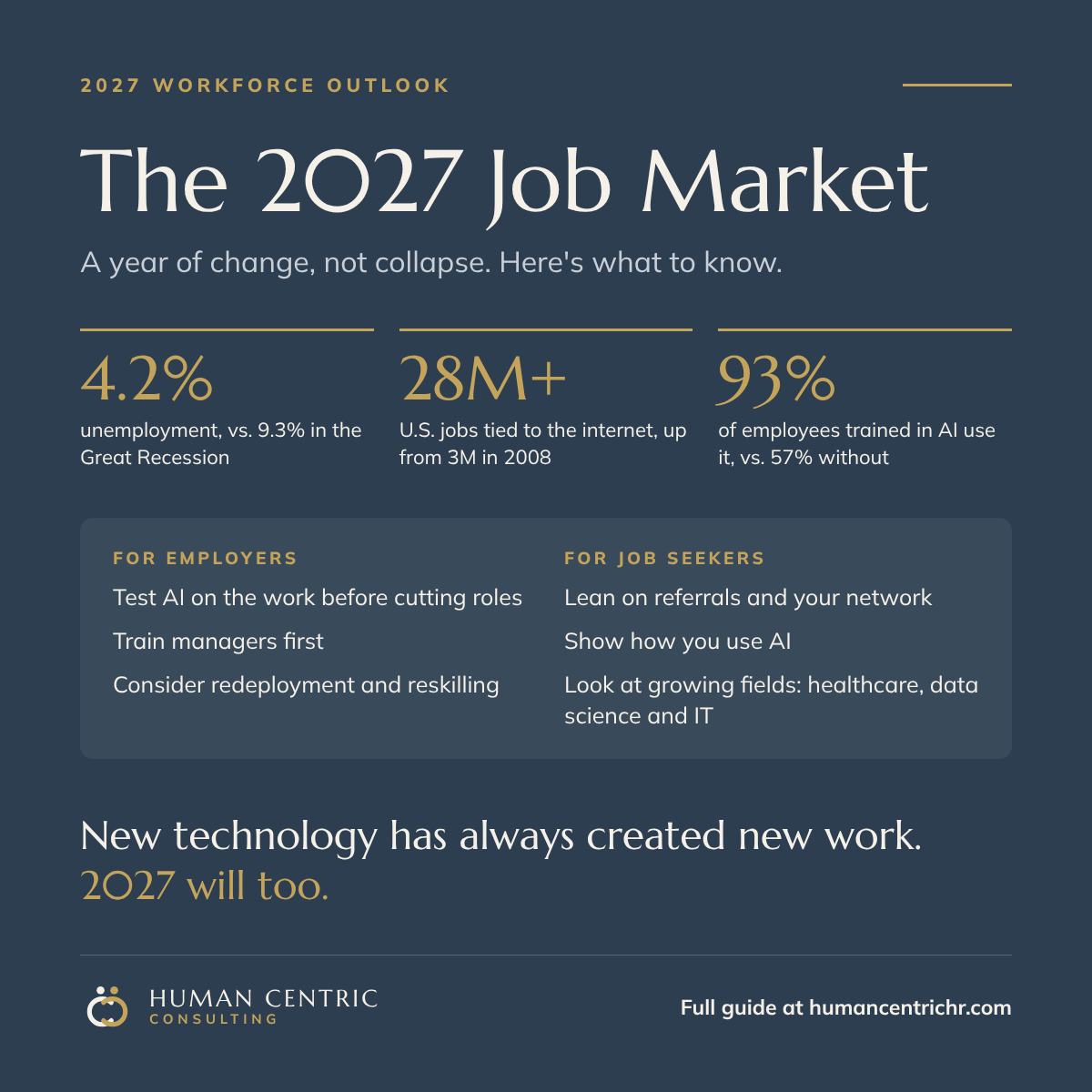
Across all industries, layoffs in 2026 are lower than last year. Tech is the big exception. And AI is being blamed for job cuts more than ever. At the same time, hiring has slowed sharply. Economists call this a "low-hire, low-fire" job market: most people are keeping their jobs, but finding a new one is harder.
Where things stand
- Overall, job cuts are down 39%. Across all industries, U.S. employers have announced 39% fewer job cuts than at this point last year, partly because 2025 included large federal government cuts.
- Tech is going the other way. Tech companies have announced 54% more job cuts than last year, and tech now makes up nearly a third of all layoffs.
- Actual layoffs across the economy are still low, and unemployment is 4.2%.
- Hiring is the problem. The U.S. added only 29,000 jobs in September.
Why are tech layoffs rising while tech skills are in demand? Tech companies are cutting some roles while hiring others as they shift toward AI. They've announced the second-most hiring plans of any industry this year, after retail. Data and IT jobs also exist in every industry, from hospitals to banks, which is why those skills keep growing even as tech companies cut.
In Arizona, announced job cuts have dropped sharply this year. Recent local layoff notices have come mostly from services, distribution and hospitality employers rather than tech.
How 2026 compares to past years
This year's layoffs look large in the headlines, but they're modest next to past downturns:
| Year | What was happening | Announced job cuts | Average unemployment |
|---|---|---|---|
| 2001 | Dot-com crash and 9/11 | 1,956,876 | 4.7% |
| 2008 | Financial crisis begins | 1,223,993 | 5.8% |
| 2009 | Great Recession | 1,288,030 | 9.3% |
| 2019 | Strong pre-pandemic market | 592,556 | 3.7% |
| 2020 | COVID-19 pandemic | 2,304,755 | 8.1% |
| 2022 | Post-pandemic hiring boom | 363,824 | 3.6% |
| 2023 | Tech correction | 721,677 | 3.6% |
| 2024 | Job market cooling | 761,358 | 4.0% |
| 2025 | Federal workforce cuts | 1,206,374 | 4.3%* |
| 2026 (Jan–Sep) | AI and tech restructuring | 573,195 | 4.2% (Sept.) |
If the current pace holds, 2026 will end with about 760,000 announced cuts. That's similar to 2023 and 2024, and far below 2009 or 2020. Unemployment is also well below recession levels. The bigger issue this year is slow hiring, not mass layoffs.
Job cuts: Challenger, Gray & Christmas. Unemployment: U.S. Bureau of Labor Statistics annual averages. *2025 is an 11-month average.
Why it's happening
AI is now the most common reason companies give for layoffs, named in about 1 in 5 job cuts. But it isn't always the real reason.
- Companies are moving money into AI. Big tech firms are spending heavily on AI and cutting staff to pay for it.
- Costs are rising. Higher energy prices, interest rates and healthcare costs are making employers cautious.
- Pandemic over-hiring. Some companies hired too many people in 2020–2022 and are still adjusting.
Some experts call this "AI-washing": blaming AI for cuts that are really about cost or over-hiring. Many companies announcing AI layoffs don't yet have AI tools ready to do that work.
How AI is going at work
Half of U.S. workers now use AI at work, but only 15% use it every day. Most say it helps them work faster. But at companies using AI, only 14% of employees strongly agree it has changed how work gets done.
Some companies have also found that AI can't replace people as easily as expected. In one survey of 600 HR leaders, about 2 in 3 employers that cut jobs because of AI had already rehired at least a quarter of those roles, often within six months.
Some well-known companies have said so publicly:
| Company | What happened |
|---|---|
| Ford (2026) | Brought back and promoted more than 350 veteran engineers after AI quality systems missed problems. Their hands-on know-how wasn't in the data the AI learned from. |
| Klarna (2025) | Its AI chatbot took over most customer chats, but the CEO admitted quality dropped. The company is now hiring human agents so customers can always reach a person. |
| Commonwealth Bank of Australia (2025) | Cut 45 call center jobs for an AI voice bot, then reversed the decision and apologized as call volumes rose. |
| IBM (2026) | After cutting jobs for automation, said it would triple entry-level hiring for roles that need human judgment, customer contact and AI oversight. |
Recruiting firm Robert Half found that 32% of U.S. hiring managers have cut a role mainly because of AI and later rehired for the same or a similar job. The lesson for employers: test AI on the work first, then decide on headcount.
Will there be jobs in the future?
Some tech leaders predict that within 10 to 20 years, AI and robots will do most work and jobs will become optional.
History suggests a different picture. MIT research found that about 60% of today's jobs didn't exist in 1940. Technology removes some jobs and creates new ones, but the new jobs don't always go to the same people or pay the same.
We've been here before. Every big technology shift has wiped out some jobs and created others:
| When | What changed | Jobs lost | What happened next |
|---|---|---|---|
| 1760s–1840s | Industrial Revolution | Hand weavers and craft workers | Factory jobs grew, but the switch was hard for a generation of workers |
| 1900s–1970s | Farm machinery | Farm work fell from about 40% of U.S. jobs to under 5% | Workers moved into factories, offices and services |
| 1910s–1920s | Electricity and the assembly line | Many skilled hand-built trades | Cheaper cars and goods created whole new industries |
| 1970s–1990s | Computers and ATMs | Typists, switchboard operators, routine clerks | IT jobs grew, and bank tellers shifted to customer service |
| 1990s–2010s | The internet | Travel agents, print, some retail | Web, e-commerce, digital marketing and social media jobs |
The personal computer is a good example. McKinsey estimates it created more than 15 million net new U.S. jobs since 1980, even after accounting for the typists, clerks and bookkeepers it replaced.
The internet had an even bigger effect. In 2008, about 3 million U.S. jobs were tied to the internet. By 2025, that number had grown to more than 28 million, including about 11 million jobs directly in the digital economy and 17 million in industries that depend on it.
The pattern is consistent. New work does arrive, but it takes years, and the people who lose jobs aren't always the ones who get the new ones. That's why training matters so much.
For now, the next three to five years look like jobs changing, not disappearing.
Training staff on AI
Training makes a big difference. Employees who get AI training are much more likely to use it (93% vs. 57%) and say they save about twice as much time. What good training looks like:
- Share a clear AI plan. Only 1 in 4 employees say their employer has one.
- Train managers first. Teams follow their manager's lead.
- Make it specific to each role. Use real tasks from people's jobs.
- Teach people to check AI's work. AI can make mistakes.
- Link new skills to career growth. This helps you keep the people you train.
What to expect in 2027
Forecasters expect unemployment to stay around 4.3–4.4%, with a small improvement in hiring. Not a boom and not a bust.
- Layoff announcements may rise in January, when new budgets take effect.
- Routine office jobs will keep shrinking, while healthcare, data science and IT jobs keep growing.
- Hiring will matter most. Layoffs are already low, so 2027 depends on whether employers start hiring again.
If you're planning to hire in 2027, recruiting support in Phoenix and US-wide can help you find the right people. Wondering about cost? Read How Much Does a Recruiter Cost?
Planning layoffs? Start here
Look at alternatives first. Layoffs are expensive and hard to undo. Before cutting, consider:
- Moving people into roles where you need help
- A hiring freeze, or not replacing people who leave
- Reduced hours or voluntary time off
- Reskilling staff for new or AI-supported work
If layoffs go ahead, cover the basics:
- Check the WARN Act. Employers with 100 or more employees generally must give 60 days' written notice before a plant closing or a layoff of 50 or more people at one site.
- Pay final wages on time. In Arizona, employees you let go must be paid within seven working days or by the end of the next regular pay period, whichever is sooner. More in our Arizona final paycheck guide.
- Get severance agreements right. If you ask employees 40 or older to sign a release, they must get 21 days to consider it (45 days in a group layoff) and 7 days to change their mind after signing. Group layoffs also require written information about who was selected.
- Plan each conversation. Decide who will tell each person, what they'll hear, and what happens next: final pay, benefits, COBRA and references.
- Support the people who stay. Tell your remaining team what happened, why, and what comes next. Silence leads to rumors and resignations.
Looking for a job? How to stand out in a slow market
- Lean on your network. When fewer jobs are posted, more roles are filled through referrals. Reach out to former coworkers and managers.
- Tailor every resume. Many employers now use AI tools to screen applications. Use the key terms from the job posting and keep formatting simple.
- Show your AI skills. Give real examples of how you use AI tools to save time or improve results.
- Focus on growing fields. Healthcare, data science and IT are among the fastest-growing areas. Government projections show healthcare support jobs growing about 13%, computer and IT jobs about 7%, and data scientist jobs about 35% over the next decade, compared with 3.5% for all jobs.
- Plan for a longer search. Budget time and money for a search that may take several months.
- If you've been laid off, check when your final paycheck is due, read any severance agreement carefully before signing, and apply for unemployment benefits through Arizona DES right away.
The bottom line
For employers: Be clear about why you're making cuts, test what AI can actually do before replacing people, plan for WARN Act requirements early (an HR audit is a good place to start), and invest in the employees you already have.
For employees: Learn to use AI, keep your resume up to date, and look at fields that are growing.
Sources
- Challenger, Gray & Christmas — Challenger Report, September 2026
- U.S. Bureau of Labor Statistics — The Employment Situation, September 2026
- Crunchbase News — Tech Layoffs Outpace 2025 As Big Companies Shift Spending To AI
- Built In — Did AI Really Take Your Job, or Is It 'AI Washing'?
- Gallup — Indicator: Artificial Intelligence
- McKinsey — The state of AI in 2026
- HR Director — Businesses rush to rehire staff after regretted AI-driven cuts
- MIT News — Does technology help or hurt employment?
- California Management Review — Why AI Training Is Driving Adoption but Not Sustainable Productivity
- Staffing Industry Analysts — Economists revise jobs projections (Philadelphia Fed)
- Indeed Hiring Lab — Economists Expect a Cooled Labor Market
- U.S. Department of Labor — Plant Closings and Layoffs (WARN Act)
- Arizona Revised Statutes § 23-353 — Final wages
- Littler — EEOC guidance on severance agreements (OWBPA)
- TechSpot — More companies are rehiring workers they replaced with AI
- Entrepreneur — Klarna is hiring customer service agents after AI couldn't cut it
- Information Age (ACS) — CBA reverses AI-driven job cuts
- U.S. Bureau of Labor Statistics — Employment status of the civilian population, annual averages
- Job Market Monitor — McKinsey research on jobs created by the personal computer
- McKinsey Global Institute — Internet matters
- IAB and Harvard Business School — Measuring the Digital Economy (2025)
- U.S. Bureau of Labor Statistics — Employment Projections, 2025–2035

About the author: Angela Innes, MBA, PHR, GPHR
Fractional HR director and recruiter based in Phoenix, AZ, with 15+ years of senior HR experience helping small and mid-sized businesses. Connect on LinkedIn.
This article is general HR information, not legal advice. Laws change, so check current requirements or speak with an employment attorney about your situation.
Book your free 30-minute consultation
Tell us what is on your HR plate and we will follow up with clear next steps. No obligation.